
Tesamorelin Research
Explore the science behind Tesamorelin, a synthetic GHRH analogue. Learn about its mechanism, published research, key studies, and the most important findings from the scientific literature.
What Is Tesamorelin?
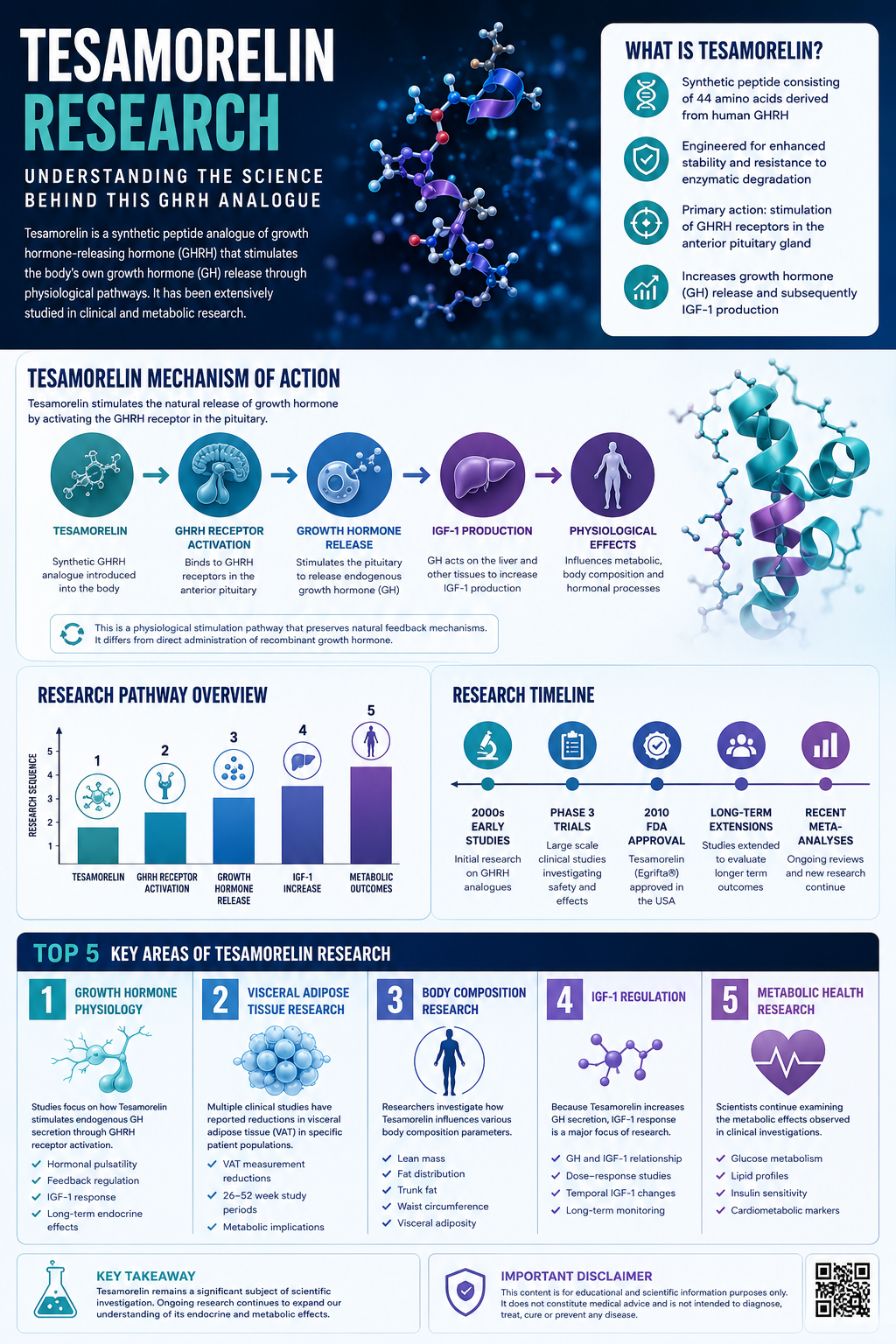
Tesamorelin is a synthetic peptide consisting of 44 amino acids derived from human growth hormone-releasing hormone (GHRH).
The peptide was engineered to improve stability and resistance to enzymatic degradation while maintaining biological activity.
Its primary action is stimulation of the GHRH receptor located within the anterior pituitary gland.
When this receptor is activated, growth hormone secretion increases, which subsequently influences circulating insulin-like growth factor-1 (IGF-1) concentrations.
Tesamorelin Mechanism of Action
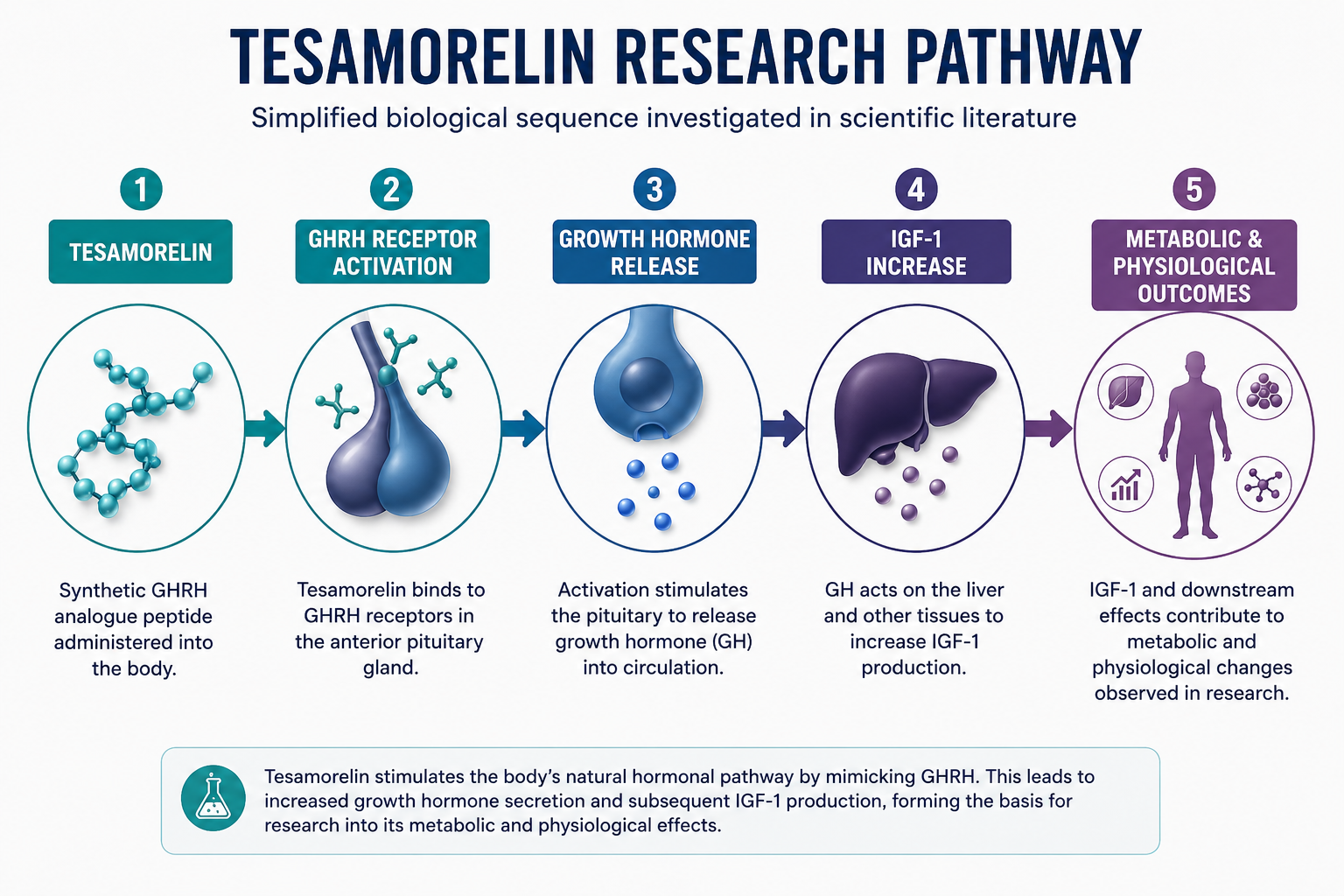
The biological pathway can be simplified as follows:
Hypothalamus
↓
Tesamorelin
↓
Pituitary GHRH Receptor Activation
↓
Growth Hormone Release
↓
IGF-1 Production
↓
Metabolic and Physiological Effects
Research indicates that Tesamorelin stimulates endogenous growth hormone secretion while preserving natural feedback mechanisms that regulate hormone production.
This physiological stimulation differs from direct administration of recombinant growth hormone.
Visual Overview: Tesamorelin Research Pathway
op 5 Most Important Areas of Tesamorelin Research
1. Growth Hormone Physiology
One of the most extensively studied aspects of Tesamorelin is its ability to stimulate endogenous growth hormone secretion through GHRH receptor activation.
Researchers have been interested in whether stimulating natural hormone release may produce different physiological effects compared with administering growth hormone directly.
Key research questions include:
- Hormonal pulsatility
- Feedback regulation
- IGF-1 response
- Long-term endocrine effects
2.Visceral Adipose Tissue Research
A significant proportion of published Tesamorelin research has examined changes in visceral adipose tissue (VAT).
Multiple clinical studies have reported reductions in VAT measurements among specific patient populations receiving Tesamorelin. Researchers continue investigating the metabolic implications of these findings.
Published studies have reported measurable reductions in visceral fat accumulation over treatment periods ranging from 26 to 52 weeks.¹²
3. Body Composition Research
Scientists have investigated how Tesamorelin influences body composition variables including:
- Lean mass
- Fat distribution
- Trunk fat
- Waist circumference
- Visceral adiposity
Body composition remains one of the most active areas of ongoing Tesamorelin investigation.
4. IGF-1 Regulation
Because Tesamorelin increases growth hormone secretion, researchers closely monitor circulating IGF-1 levels.
Understanding the relationship between:
- Tesamorelin exposure
- Growth hormone secretion
- IGF-1 concentrations
remains a major focus of endocrine research.
5. Metabolic Health Research
Researchers continue examining:
- Glucose metabolism
- Lipid profiles
- Insulin sensitivity
- Cardiometabolic markers
Although findings vary between studies, metabolic outcomes remain a key area of scientific interest.
Key Scientific Findings
Published literature consistently reports several observations:
Endogenous Hormone Stimulation
Tesamorelin acts by stimulating the body's own growth hormone production rather than supplying exogenous growth hormone.
Increased IGF-1 Levels
Studies have demonstrated increases in circulating IGF-1 concentrations following administration.
Visceral Fat Research
Multiple controlled studies have reported reductions in visceral adipose tissue measurements in specific study populations.
Long-Term Investigation
Extension studies have allowed researchers to observe outcomes over periods approaching one year and beyond.
How Tesamorelin Differs From Other GHRH Analogues
Tesamorelin belongs to the broader family of GHRH analogues.
Compared with earlier compounds, it was designed to improve:
- Stability
- Biological activity
- Resistance to degradation
- Receptor interaction
These characteristics contributed to its extensive investigation in clinical research.
Frequently Asked Questions
Is Tesamorelin a growth hormone?
No. Tesamorelin is a growth hormone-releasing hormone analogue that stimulates endogenous growth hormone release.
Is Tesamorelin a peptide?
Yes. Tesamorelin is a synthetic peptide consisting of 44 amino acids.
What receptor does Tesamorelin target?
Tesamorelin primarily targets the GHRH receptor within the anterior pituitary gland.
Why is Tesamorelin important in research?
Researchers use Tesamorelin to investigate growth hormone physiology, body composition, endocrine regulation, and metabolic outcomes.
Is Tesamorelin still being studied?
Yes. New publications continue to evaluate its endocrine and metabolic effects in various research settings.
Conclusion
Tesamorelin remains one of the most extensively studied GHRH analogue peptides in the scientific literature.
Its ability to stimulate endogenous growth hormone release through physiological pathways has made it an important tool for researchers investigating endocrine regulation, body composition, metabolic health, and growth hormone physiology.
As research continues, Tesamorelin is likely to remain a significant subject of interest within peptide science and hormone-related investigation.
Sources
- Spooner LM, Olin JL. Tesamorelin: A Growth Hormone-Releasing Factor Analogue for HIV-Associated Lipodystrophy.
- PubMed Clinical Review Literature.
- FDA approval documentation for Tesamorelin.
- Peer-reviewed endocrine and metabolic research publications.
IMPORTANT COMPLIANCE NOTE:
This article is provided for educational and scientific information purposes only. It does not constitute medical advice and does not make claims regarding diagnosis, treatment, cure, mitigation, or prevention of disease. Any commercial product references should remain clearly separated from educational content and comply with applicable UK regulations.